Tuesday, October 4, 2011

Repose - Saying Goodbye


Donna at Garden Walk Garden Talk has offered the word, repose, for Word for Wednesday. Repose is such an appropriate word for this time of year when the garden is slowly moving towards its rest period. We, as gardeners, are winding down our weeding, planting, and garden maintenance. Although I like the flurry of activity in the garden during the spring and summer, I welcome the shift to a slower rhythm once autumn arrives.


Although autumn is a time when things slow down, it is also a time for goodbyes. Nests have been abandoned and saved for next year's nestlings.


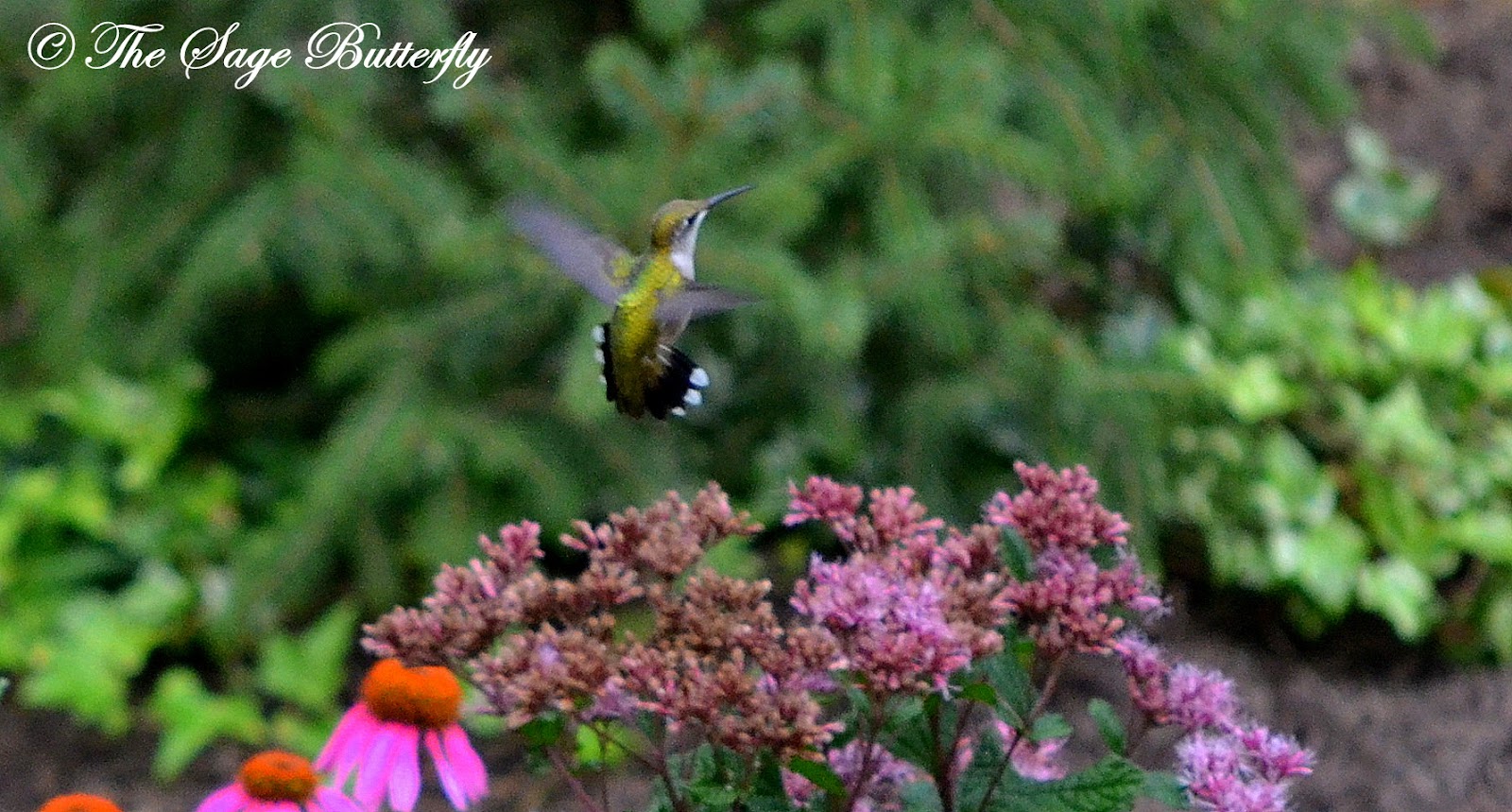
Hummingbirds make their annual migration south and say goodbye until next spring. With the cooler weather, they even seem to find time for repose.


These delicate, yet robust, creatures bring me such joy in the garden. I will miss their elegant beauty, that puff of their wings as they sprint by my ear, and that high-pitched and quick chirp they make as they dance around the blooms and the feeders.



Even the butterflies say goodbye as they search for sheltered spots for a chrysalis or they migrate south as the Monarch. Because I could not sufficiently support the Monarch when my butterfly milkweed plant was damaged in the hurricane, I was not sure I would even see any this year. How elated I was when one showed up to give me an autumn goodbye kiss.


A falling leaf landed on a branch of leaves to offer another form of repose.


Repose = restfulness, calm, leisure, peace, quiet, restoration...


Another goodbye to the Hope Grows Day meme. Hanni at Sweet Bean Gardening has turned Hope Grows Day into Hope Grew. She has decided to end this meme's run. Thank you, Hanni, for hosting Hope Grows Day. I will miss thinking about my garden hopes month after month. My hope for October is that the serenity and repose of autumn continues throughout the season.


©Michelle A. Potter

Saturday, October 1, 2011

A Few Notes, a Photo Honor, and Elderberry Pie


I have been offline for about a week to take some time off to visit with friends and relatives. I will be sharing more about my visits soon.

~~~~~~~~~~~~~~~~~~~~~~~~

Gardening Gone Wild just announced the winners of September's Picture This Photo Contest, and I won Honorable Mention for this photo.


I am honored by this encouraging gesture. And I offer congratulations to all the other winners, especially the Silver and Gold medal winners. Their photos are stunning and highly deserving of the honors they have recieved. Take a look at the Silver and Gold medal honoree photos and the other Honorable Mentions at Gardening Gone Wild.

~~~~~~~~~~~~~~~~~~~~~~~~

A couple of weeks ago, Holly Bose wrote a guest post about elderberries. Many of you were looking forward to the pie recipe. She has recently posted an Elderberry Raspberry Pie Recipe.
©Michelle A. Potter

Wednesday, September 21, 2011

Illumination, Late Summer Light - GGW Photo Contest

Late summer offers such a perfect introduction to fall because it slowly begins the seasonal transition with the changes in light, temperature, and even breezes. The light of the sun lower in the sky presents new shadows and a different kind of illumination than the direct light of summer high in the sky.

This will be my first time entering Gardening Gone Wild's Picture This Photography Contest. This month's theme is Late Summer Garden. I enjoy taking photos in my garden and experimenting with the camera, so, for me, it is a joy to enter. Finding the photo that would represent the theme was a challenge.  I like the colors of this photo as well as the idea of looking beyond an image in the foreground.


This photo fit the requirement for a late summer garden and the suggestion of shooting tight.


Spider webs seem to be all over the garden. I try not to disturb them, but there are times I must release one corner of the silk to pass through a path.


The late summer garden is filled with fresh blooms and fading blooms. The seedheads boldly reach up to the sky and the petals fold down and crisp at the edges.


Blooms are in transition and offer different views and lights.


This fennel in bloom photo has a gossamer-like view between the stems and leaves.


I decided on entering this photo of a clematis seedhead. I liked the lone seedhead against the fading seedheads and colors in the background.


I am joining Donna at Garden Walk Garden Talk for Word for Wednesday. The word for today is illumination, an apt word for this time of year.
©Michelle A. Potter

Monday, September 19, 2011

Elderberries

Today’s post is a guest post from Holly Bose at Your Gardening Friend.


In recent conversations, I've come to learn that not everyone knows what an elderberry is.  Had my mom not given us the experience of delicious homemade elderberry pies, and elderberry syrup, I too would not know of this tasty creation.

An elderberry is a very small, round, fruit berry with interior seeds. When I say it's a "small" berry, I mean REALLY small. An elderberry is between the size of a BB and a pea. The berries should not be eaten unless cooked (because of toxins), and, unlike most other berries, they require some sweetening.


The general parts of an elderberry bush are as follows:

       1. Roots
       2. Canes
       3. Lateral Branches
       4. Leaves
       5. Flowers (white)
       6 .Berry Clusters


Finding Elderberry Bushes
While you may find elderberry bushes in more than one type of setting, you're most likely to see them growing near the roadside, in ditches, along railroad tracks, and other similar locations, in wide open spaces with full sunlight.

Because these areas are not often mowed, you may find the elderberry bushes growing in the midst of other plants, weeds, and tall grasses. Even to the trained eye it can be a little challenging to spot them while driving 45-60 mph. The easiest way to find elderberry bushes is to look for them when they're in bloom. Come spring, specifically the month of May (at least for Indiana), the canopies of white blooms are a stark contrast against the surrounding greenery, and can be seen while driving down the road.
 
Harvesting Elderberries
After the flowers are pollinated, small green berries emerge.  As the berries mature, the green eventually turns into a medium purple, and the purple into a deep, dark, shiny purply-black color.  It is at this point the berries are ready for pickin', around mid-August to mid-September.

The best way to pick them is to break off the entire cluster of berries and place them in a clean plastic bag. Double-bagging is a good idea to make sure the branches don't puncture the plastic bag.

Once you get home, place the plastic bag of berries, including the branch stems, in the freezer. After the berries are frozen, take the entire bag and set it on the kitchen counter. Tap the bag on the counter numerous times. This will cause the frozen berries to break off the cluster. You can then place all the berries in a freezer storage bag until you're ready to make a pie. (My brother shared with me this method of removing the berries from the clusters.)


Because elderberries are an acidic fruit, canning them does not require the investment of a pressure canner/cooker. You need only a boiling pot.

Stay tuned for an upcoming elderberry pie recipe. Yummy!!!

Holly lives in Indiana with her husband and three canine children.  They live in the country, nestled in the woods, surrounded by nature.  She writes about gardening and her love of wildlife on her blog, Your Gardening Friend.

Wednesday, September 14, 2011

All That Basil


By this time each year, my basil plants have grown tall and full of basil leaves. Although I harvest the basil throughout the season, this time of year is when I spend a lot of time preserving it. Basil is a very aromatic and versatile herb that can be used in numerous dishes and teas, and so I like to have it on hand during the winter for soups, pastas, vegetable dishes, and salads.


Harvesting
The best time to harvest basil is the early morning after the dew has dried. Try to harvest before the plant flowers for optimum flavor.To harvest basil cut at a leaf joint about three to six inches from the top. The basil will continue...[Read the rest of this post over at Your Gardening Friend...]

©Michelle A. Potter
Related Posts Plugin for WordPress, Blogger...
ondragstart="return false" onselectstart="return false"